Two weeks ago, U.S. spot Bitcoin ETFs had their worst day since June. Last week, they had their best week since October of last year. Same funds, same holders, same underlying asset — and the swing between the two says less about Bitcoin than it does about how tightly ETF flows are now wired into broader macro and policy sentiment.
What actually went wrong first
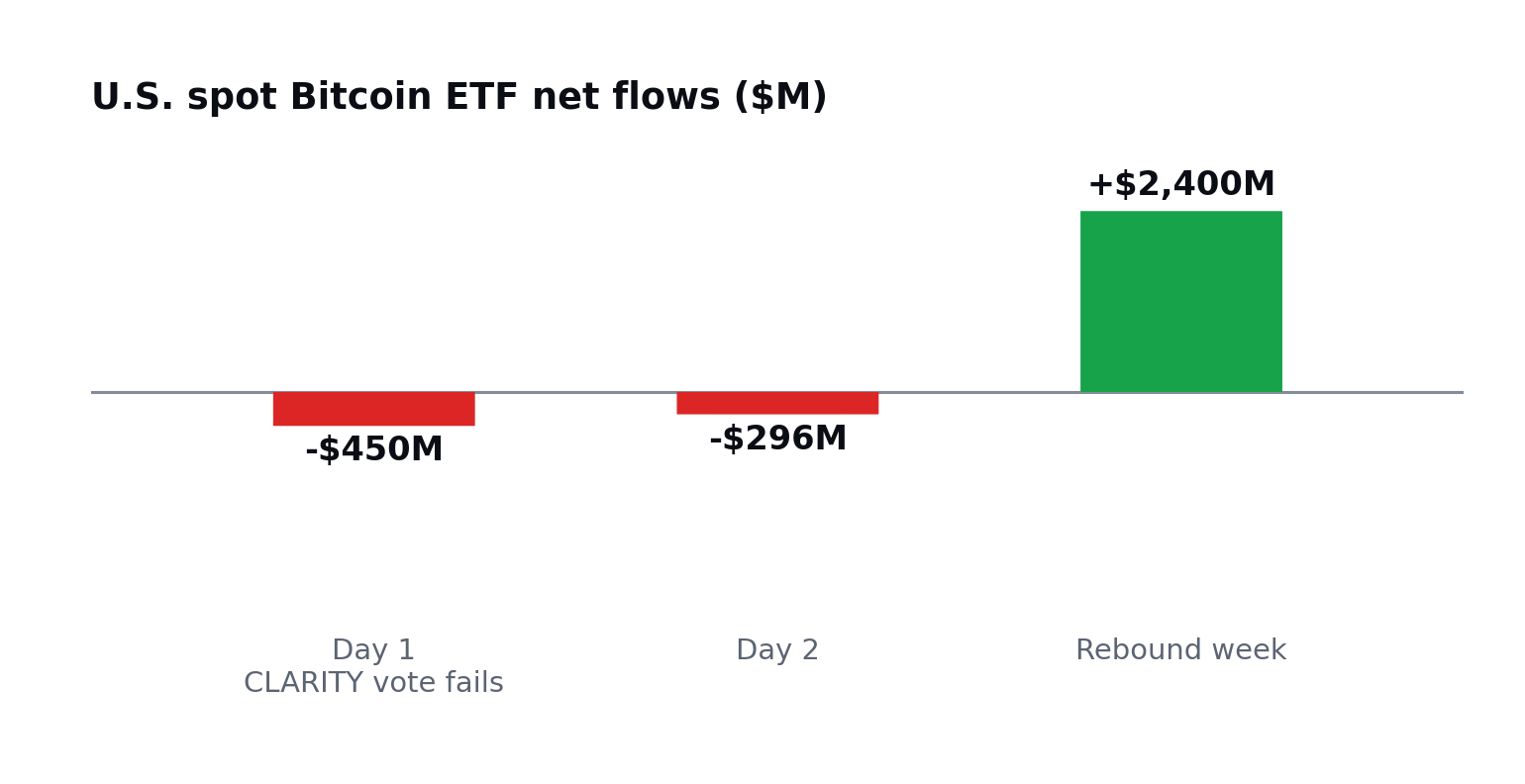
The trigger for the scare was political, not technical: when the CLARITY Act failed its Senate cloture vote, Bitcoin ETFs posted their worst single day since June — about $450 million in net outflows — followed by another $296 million the next day. That's a meaningful amount of money heading for the exits over crypto-specific federal legislation stalling, and it read, briefly, like the start of a longer unwind.
What actually turned it around
It wasn't a crypto story at all. The Treasury Department's announcement of increased long-dated bond buybacks shifted sentiment across risk assets broadly, and Bitcoin ETFs caught the updraft along with everything else. The following week, U.S. spot Bitcoin ETFs pulled in $2.4 billion in net inflows — their largest weekly haul since October of last year — enough to push 2026 year-to-date flows back into positive territory, at roughly $934 million net positive, after a stretch that had been running as deep as $5.29 billion in the red earlier in the year.
Same issuers, both directions
BlackRock's IBIT led the rebound with $1.2 billion of that week's inflows — notably, IBIT had also accounted for roughly 85% of the single worst outflow day two weeks earlier, at $201.18 million. Fidelity's FBTC added $701.7 million on the way back up after losing $43.67 million on the way down. Ark and 21Shares' ARKB brought in $294.7 million. The overlap in which funds led both the selloff and the rebound is the real story here: this isn't new money entering the market so much as the same large, sentiment-driven allocator base moving in and out together, amplifying whatever the macro narrative of the week happens to be.
Bitcoin's price did its part too
The rebound coincided with Bitcoin's price climbing back toward $84,000, which matters for flow dynamics beyond simple sentiment: at that level, the typical ETF holder who bought sometime in the last year is back in unrealized-profit territory rather than sitting on a paper loss. Historically, flows into Bitcoin ETFs are stickier and larger when the median holder is profitable, since investors are more willing to add to a winning position than to average down into one that's underwater — a dynamic that can make ETF flows something of a lagging amplifier of price moves rather than a leading indicator of them.
Why it matters
A year ago, the idea that Bitcoin ETF flows would swing by billions of dollars based on a Treasury bond-buyback announcement rather than crypto-native news would have sounded like a stretch. Now it's just how the asset class trades: spot Bitcoin ETFs have made Bitcoin exposure a normal line item in diversified portfolios, which means it now responds to the same macro triggers — rate expectations, Treasury issuance policy, risk-on/risk-off sentiment — that move every other major asset class. That's arguably a sign of maturity, but it also means the next big test isn't necessarily another regulatory vote or exchange hack — it's whatever the bond market does next. For anyone using ETF flow data as a sentiment gauge, that's a genuinely different analytical exercise than it was even a year ago: reading Bitcoin ETF flows now increasingly means reading Treasury policy and rate expectations first, and crypto-specific headlines second, rather than the other way around. It also means the next serious test of whether Bitcoin ETFs have staying power as a mainstream allocation will likely arrive disguised as an ordinary fixed-income story, not a crypto one — which is exactly the kind of test a genuinely mature asset class is supposed to face. Whether Bitcoin actually passes that test — holding steady or gaining ground during a real fixed-income shock rather than simply amplifying whatever mood the bond market sets — is the open question this month's whipsaw hasn't yet answered either way.
Further reading
- The Block: Bitcoin ETFs turn positive for 2026 with $2.4 billion weekly inflow, their largest since October
- Trending Topics: Bitcoin ETFs Turn Positive for 2026 After $2.4 Billion Week
- CoinGlass: Bitcoin ETF Fund Flows — Spot BTC Net Inflow & Holdings
Frequently asked
What actually caused the September outflows?
The CLARITY Act's failure in a Senate cloture vote triggered Bitcoin ETFs' worst single day since June — about $450 million in outflows, followed by another $296 million the next day — as investors reacted to the setback for crypto-specific federal legislation.
What reversed it, if it wasn't crypto-specific good news?
The Treasury Department's announcement of increased long-dated bond buybacks shifted broader market sentiment, which fed through to risk assets generally, including Bitcoin ETFs — a reminder that Bitcoin ETF flows are as exposed to macro fixed-income policy as they are to crypto-specific headlines.
Which ETF issuers benefited most from the rebound?
BlackRock's IBIT led with $1.2 billion of the rebound week's inflows, followed by Fidelity's FBTC at $701.7 million and Ark/21Shares' ARKB at $294.7 million — roughly the same issuers that had led the prior outflows, underscoring that these are largely the same investor base moving in and out together rather than new money replacing old.