For the first few years of corporate Bitcoin treasuries, there was really only one strategy: buy, announce it, and never sell. That uniformity has quietly broken down in 2026. Public companies holding Bitcoin are now splitting into three distinct camps — and the split says as much about how mainstream corporate Bitcoin holding has become as any single company's balance sheet does.
The three camps
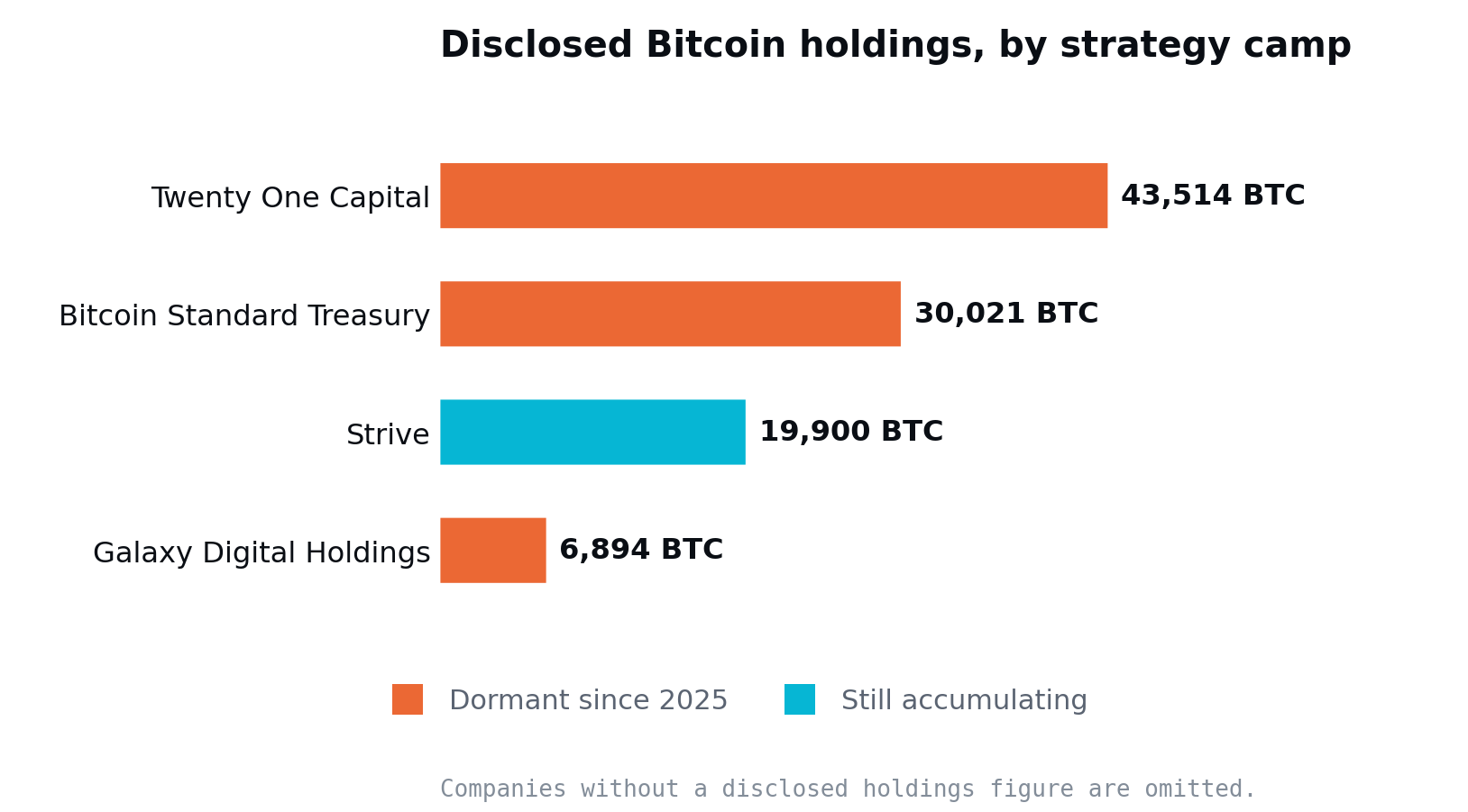
The first group has gone completely dormant: companies like Galaxy Digital Holdings (6,894 BTC), Bitcoin Standard Treasury (30,021 BTC), and Twenty One Capital (43,514 BTC) have made no reported moves since 2025, treating their holdings as a pure buy-and-hold position with no active management at all. The second group keeps accumulating: American Bitcoin Corp, Strive, Metaplanet, Coinbase, Block Inc., and SpaceX have all continued adding to their positions through 2026, with Strive's July 13 purchase bringing its holdings to 19,900 BTC as one recent example. The third group has actually been reducing exposure: Riot Platforms, MARA Holdings, Trump Media, and Strategy have all sold meaningful amounts this year.
The most interesting case is the seller that came back
MARA Holdings' pattern is worth a closer look because it doesn't fit a simple narrative in either direction. The company sold more than 18,000 BTC across March and May of 2026, which on its own would read as a straightforward reduction in conviction. But it then added back a modest 1,000 BTC in June — not a reversal back to accumulation, but also not a clean exit. That pattern looks less like a change of heart about Bitcoin as an asset and more like active treasury management: selling into strength, raising liquidity for operational needs, or rebalancing against mining-specific capital requirements, all while keeping some exposure rather than going to zero.
Why the split matters more than any single company's move
When only a handful of companies held Bitcoin on their balance sheets, uniform buy-and-hold behavior made sense — those companies were all making the same early, high-conviction, first-mover bet, and backing off would have undercut the entire thesis they'd publicly staked their reputation on. Now that corporate Bitcoin holding is common enough to include miners, fintechs, aerospace companies, and media companies with very different balance sheets and very different reasons for holding it in the first place, a uniform strategy across all of them would actually be the surprising outcome. Divergence is what you'd expect once an asset moves from "a statement of belief" to "a normal treasury allocation decision," made or unmade based on each company's own capital needs rather than a shared ideological commitment.
What to actually watch going forward
The useful signal from here isn't whether the aggregate total of corporate Bitcoin holdings goes up or down in any given quarter — it's whether the accumulator group keeps growing in number (more companies entering, not just existing holders buying more) versus the seller group growing (existing holders exiting entirely, not just trimming). The former would suggest corporate Bitcoin adoption is still in its early innings; the latter would suggest the asset is losing its appeal as a treasury holding even among companies that already made the initial commitment.
Why it matters
A single company's Bitcoin sale used to be treated as a headline-grade signal about institutional confidence in the asset overall. That framing doesn't really hold anymore — with dozens of public companies now holding meaningful Bitcoin positions for a wide range of company-specific reasons, no single sale or purchase carries the same weight it once did. The more useful lens going forward is exactly the three-way split this data shows: not whether corporate Bitcoin holding is growing or shrinking in aggregate, but which specific companies are in which camp, and why. A miner selling to fund operations tells you something entirely different than a media company exiting its position outright, even though both would show up identically in a simple aggregate holdings chart — and conflating the two is exactly how a genuinely nuanced, three-way story gets flattened into a misleading single headline about corporate conviction rising or falling. The more this data set grows, the less any single company's move should be read as a referendum on Bitcoin itself.
Further reading
- Coinpedia: Bitcoin Treasury Strategy Splits as Corporate Holders Take Different Paths
- Trinity Insights: Bitcoin Treasury Companies (September 2026) — Corporate BTC Holdings Tracker
- Bitcoin Treasuries: Bitcoin Treasury News and Digital Asset Treasury Updates
Frequently asked
Which companies are still buying Bitcoin?
American Bitcoin Corp, Strive, Metaplanet, Coinbase, Block Inc., and SpaceX have all continued purchasing through 2026 — Strive, for instance, brought its holdings to 19,900 BTC with a July 13 purchase.
Which companies have been selling?
Riot Platforms, MARA Holdings, Trump Media, and Strategy have all reduced their Bitcoin positions this year. MARA Holdings sold more than 18,000 BTC across March and May before adding back a modest 1,000 BTC in June — a pattern that looks more like active position management than a simple exit.
Does this divergence mean the 'corporate Bitcoin adoption' story is over?
Not necessarily — it means the story has matured past its uniform early phase. A single dominant strategy (buy and never sell) made sense when few companies held Bitcoin and were all making the same first-mover bet; with more companies holding it now, for different reasons and under different financial pressures, divergent strategies are actually a sign the asset has become normal enough to be treated like any other treasury holding — managed actively rather than held on faith alone.