Layer-2 tokens just had their best stretch of 2026, climbing 65% off the sector's low point of the year to a combined $11.5 billion market cap — nearly back to where the group started January. The timing is a little awkward: the rally is happening seven months after Ethereum's own creator publicly questioned whether most of these networks' original reason for existing still holds up.
The numbers behind the rebound
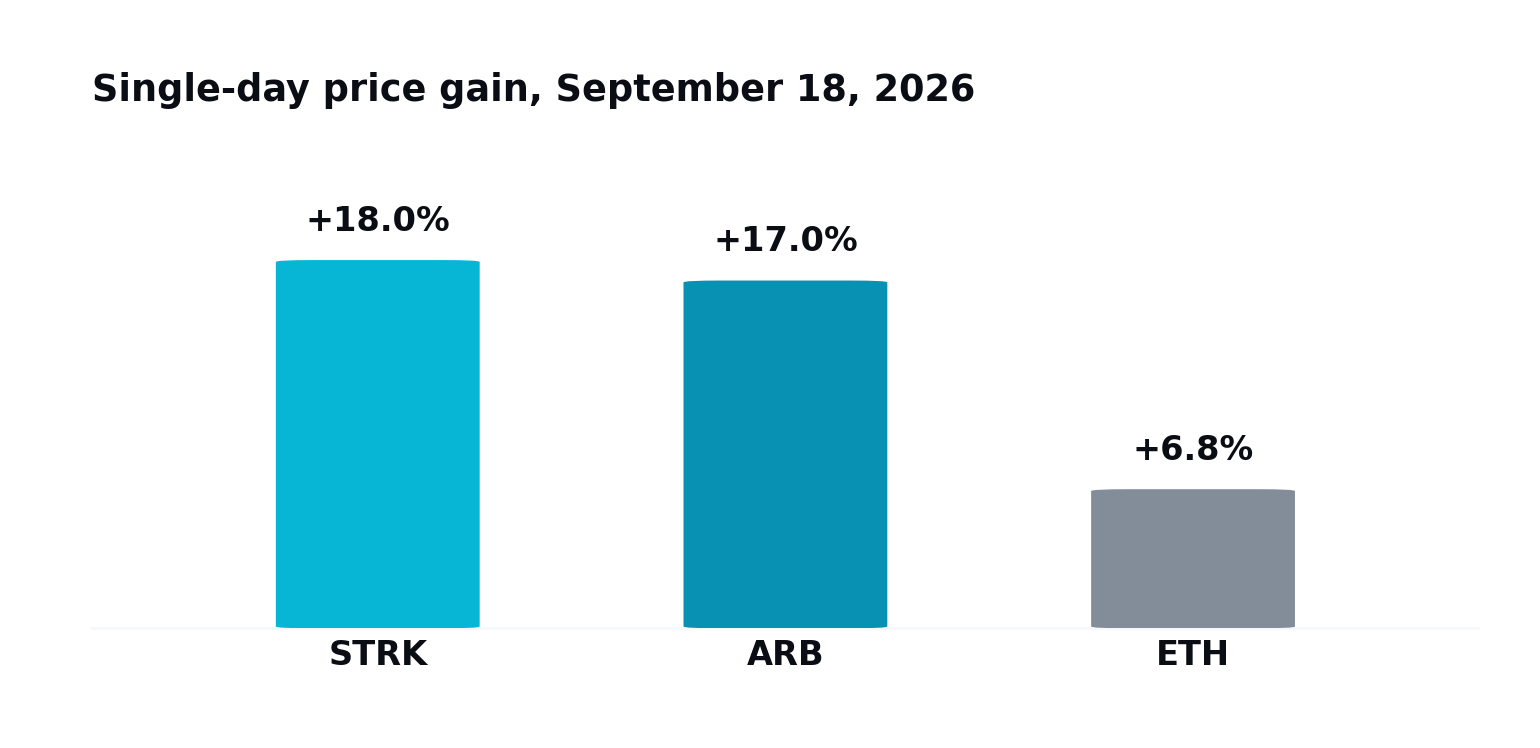
The Layer-2 sector had fallen to roughly $7 billion by late July 2026 before this rebound, meaning the 65% climb represents a real recovery of value lost over the preceding months, not just a fresh high. Standard Chartered's analyst coverage of Arbitrum on September 16 — including year-end and 2030 price targets from a major traditional-finance research desk, a notable form of institutional legitimacy for a token that had previously been covered almost exclusively by crypto-native analysts — appears to be the proximate trigger. Two days later, ARB jumped roughly 17% in a single day, with Starknet's STRK gaining 18% the same day, both meaningfully outpacing Ethereum's own 6.8% gain over the same period. Other major L2 tokens tied to Optimism, ZKsync, and Mantle moved with the broader sector, while Coinbase's Base — which has no token of its own — sat outside the rally entirely, a reminder that not every major L2 by usage is even structured to capture a token-price rally in the first place.
The awkward timing
Back in February, Vitalik Buterin said plainly that the original vision of layer-2s as "branded shards" of Ethereum no longer makes sense. His reasoning had two parts. First, Ethereum's own base layer is scaling faster than the L2 ecosystem originally assumed it would, with planned gas-limit increases arriving through 2026 — meaning some of the transaction capacity L2s were built to provide is becoming redundant as Ethereum itself gets faster. Second, and more pointedly, many of the most popular L2s — Arbitrum and Base among them — still rely on centralized sequencers controlled by their own operating companies rather than achieving meaningful decentralization. Buterin's argument was that a network using Ethereum's branding and security story while running a centralized sequencer is, functionally, a separate blockchain wearing an Ethereum badge, not a true extension of Ethereum itself.
What Buterin actually wants instead
Rather than scrapping L2s altogether, Buterin's proposal was for them to specialize: privacy-focused execution environments, application-specific chains optimized for one particular use case, ultra-low-latency networks for trading, or entirely non-financial applications — distinct value propositions rather than interchangeable, generic scaling capacity. Networks that use Ethereum specifically should hit at least "training wheels" levels of real decentralization, in his view, or else they're just separate chains relying on a bridge and a shared brand rather than genuinely inheriting Ethereum's security.
Why the rally doesn't resolve the argument
A 65% token-price rebound driven by one analyst's coverage of one L2 doesn't actually settle Buterin's underlying critique — it just shows that institutional attention can move token prices regardless of whether the sector has answered the specialization-versus-redundancy question he raised. Arbitrum, Starknet, and the rest of the sector rallying together, rather than the market differentiating sharply between L2s that have found a genuine specialized niche and ones still running as generic, centralized-sequencer scaling chains, suggests the rally is more about renewed risk appetite and institutional legitimacy than about the market actually resolving which L2s deserve to exist long-term under Buterin's own framework.
Why it matters
For anyone holding or evaluating L2 tokens, the practical takeaway is to treat a sector-wide rally as exactly that — sector-wide, not company-specific — and to separately ask, for each individual network, whether it has a genuinely differentiated use case or decentralization roadmap versus simply being interchangeable scaling capacity that Ethereum's own base-layer improvements could eventually make redundant. Buterin's February critique didn't call for L2s to disappear; it called for the market to start telling them apart. This rally, so far, hasn't done that.
Further reading
- CryptoTimes: Layer 2 Tokens Climb 65% From Their 2026 Low to $11.5 Billion, Recovering Most of a 40% Slide
- DL News: Ethereum layer 2 rethink? Vitalik Buterin floats new roadmap amid price plunge
- CoinDesk: Not all Ethereum layer 2s are dying, but many general-purpose chains no longer have a reason to exist
Frequently asked
What actually triggered this specific rally?
Standard Chartered's analyst coverage of Arbitrum on September 16, which included year-end and 2030 price targets, appears to be the proximate trigger — ARB jumped roughly 17% in a single day two days later, with Starknet gaining 18% the same day, both outpacing Ethereum's own 6.8% gain over the same period.
What exactly did Vitalik Buterin say was wrong with the original L2 vision?
In February 2026, Buterin said the original vision of layer-2s as 'branded shards' of Ethereum no longer makes sense, for two reasons: Ethereum's own base-layer scaling is improving faster than expected (making some L2 capacity redundant), and many popular L2s still rely on centralized sequencers rather than being meaningfully decentralized, making them functionally separate chains that merely borrow Ethereum's security branding.
Does this mean Layer-2 tokens are still a bad long-term bet?
Not uniformly — Buterin's critique specifically favors L2s that specialize (privacy-focused execution, application-specific optimization, non-financial use cases) and hit real decentralization milestones over generic, interchangeable scaling chains. The rally itself doesn't distinguish between the two categories, which is exactly the risk: a rising token price doesn't tell you whether a given L2 has a differentiated long-term reason to exist.