While U.S. regulators spent 2026 arguing over stablecoin capital requirements and bank charters, Latin America quietly turned stablecoins into working financial infrastructure. New data puts the region's crypto economy at $593.8 billion for 2026 — up 9.8% even as global crypto markets contracted — and the growth engine underneath that number is remittances, not speculation.
The corridor that proves the point
Mexico's cross-border remittance corridors — among the largest in the world, given the volume of money sent from the U.S. to family in Mexico — saw monthly stablecoin transfer activity reach $1.8 billion by mid-2026. That's not a pilot or an experiment; that's a meaningful share of a corridor traditionally dominated by services like Western Union and MoneyGram, which charge fees that can run several percentage points per transfer and often take a day or more to settle. A stablecoin transfer settles in minutes for a fraction of the cost, and the appeal for both senders and recipients is straightforwardly financial, not ideological.
A very uneven map
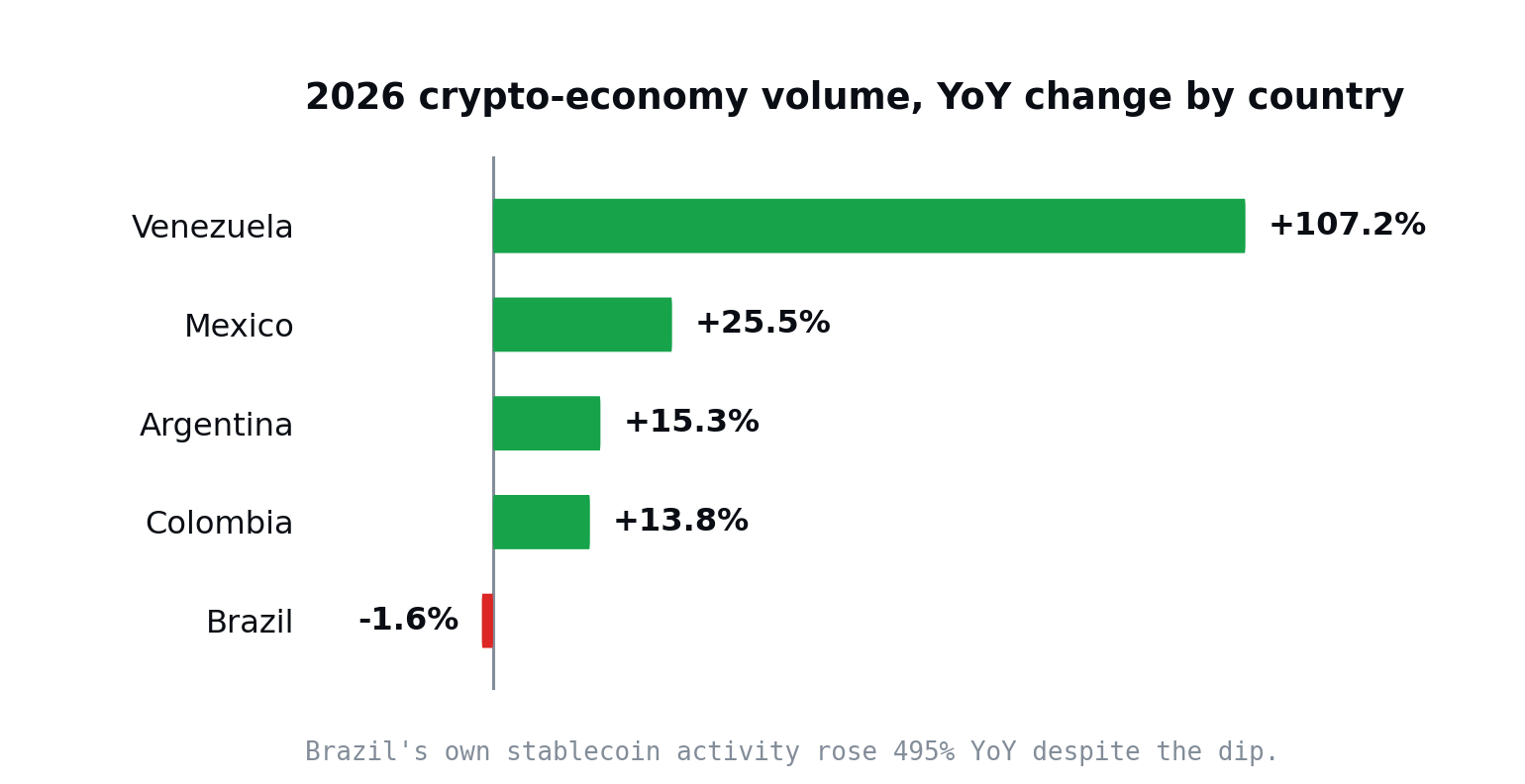
The regional number hides enormous variation. Brazil remains the largest single market at $252.5 billion — nearly half of all regional activity — though its own volume actually contracted 1.6% even as its stablecoin-specific activity rose 495% year over year, a sign that stablecoins are gaining share of a shrinking overall pie rather than simply riding a rising tide. Mexico, the third-largest market at $77.6 billion, grew 25.5%. Argentina grew 15.3%, with more than 70% of crypto purchases there tied to USDC or USDT specifically — a direct hedge against a currency with a long history of instability. Colombia grew 13.8%. And Venezuela is the outlier that explains why this region moves differently than any other: crypto activity there surged 107.2%, driven not by convenience but by necessity, as hyperinflation and capital controls push people toward dollar-pegged assets as a basic store-of-value tool rather than a payments innovation.
Domestic platforms are starting to compete, too
One structural shift worth watching: domestic Latin American platforms now capture about 12.5% of regional crypto inflows, up from just 1.5% two years ago. That's a meaningful erosion of the advantage international exchanges used to hold in the region, and it suggests the infrastructure for buying, holding, and moving stablecoins is maturing locally rather than staying entirely dependent on platforms based in the U.S. or Asia — a pattern that tends to accelerate adoption further, since local platforms are faster to build compliance and banking relationships tailored to each country's specific regulatory quirks.
Where this leaves traditional remittance companies
Across the region, stablecoins now account for 32% of cross-border transaction value, 22% of domestic peer-to-peer activity, and 17.6% of personal wallet balances — numbers that would have sounded implausible five years ago for what was, at the time, dismissed as a purely speculative asset class. Traditional remittance companies aren't disappearing, but they're increasingly competing against a cheaper, faster alternative in exactly the corridors where their own fees have historically been highest, which is precisely where a competitor has the most room to win share.
Why it matters
This is one of the clearest real-world tests anywhere in the world of whether stablecoins deliver on their core promise — cheaper, faster money movement for ordinary people, not just crypto traders — and the Latin American data suggests the answer is genuinely yes, at least in specific corridors with high traditional fees or unstable local currencies. It's also a useful counterweight to the U.S.-centric framing of most stablecoin coverage this year: while American regulators debate capital requirements for products aimed at U.S. consumers, the actual mainstream adoption story so far has played out fastest in exactly the markets those debates rarely mention. It's also a preview of what regulators writing U.S. stablecoin rules should probably be paying closer attention to: a rail this large, moving this much real remittance volume, eventually intersects with the same anti-money-laundering and sanctions-compliance questions U.S. regulators are already wrestling with domestically — just at a scale and speed that got here well ahead of the policy conversation catching up to it. Whatever shape U.S. stablecoin rules ultimately take, Latin America's remittance corridors are already showing what the technology looks like at real, non-speculative scale.
Further reading
- Blockchain.News: LATAM Crypto Economy Hits $593.8B in 2026, Stablecoins Surge
- Chainalysis: 2026 LATAM Crypto Adoption — Latin America Grew 9.8%
- Rain: State of Stablecoins in Latin America
Frequently asked
Is this replacing traditional remittance services like Western Union?
It's competing hard in specific corridors rather than replacing them outright. Stablecoins now represent 32% of cross-border value across Latin America, but traditional remittance services remain dominant in many corridors — the shift is fastest where fees and delays on legacy rails are worst, and slowest where banking infrastructure is already efficient.
Why is Venezuela's growth so much higher than everywhere else?
Venezuela's crypto activity surged 107.2% in 2026, driven less by remittance convenience and more by necessity — hyperinflation and capital controls have made dollar-pegged stablecoins a practical way to preserve savings and transact when the local currency and banking system are unstable, a pattern distinct from the cost-and-speed motivations driving adoption elsewhere in the region.
Which stablecoins are actually being used?
The two dominant dollar-pegged stablecoins, USDC and USDT, account for the overwhelming majority of activity — in Argentina, for instance, more than 70% of crypto purchases are tied to one of the two. Region-specific or algorithmic stablecoins have not gained comparable traction.